

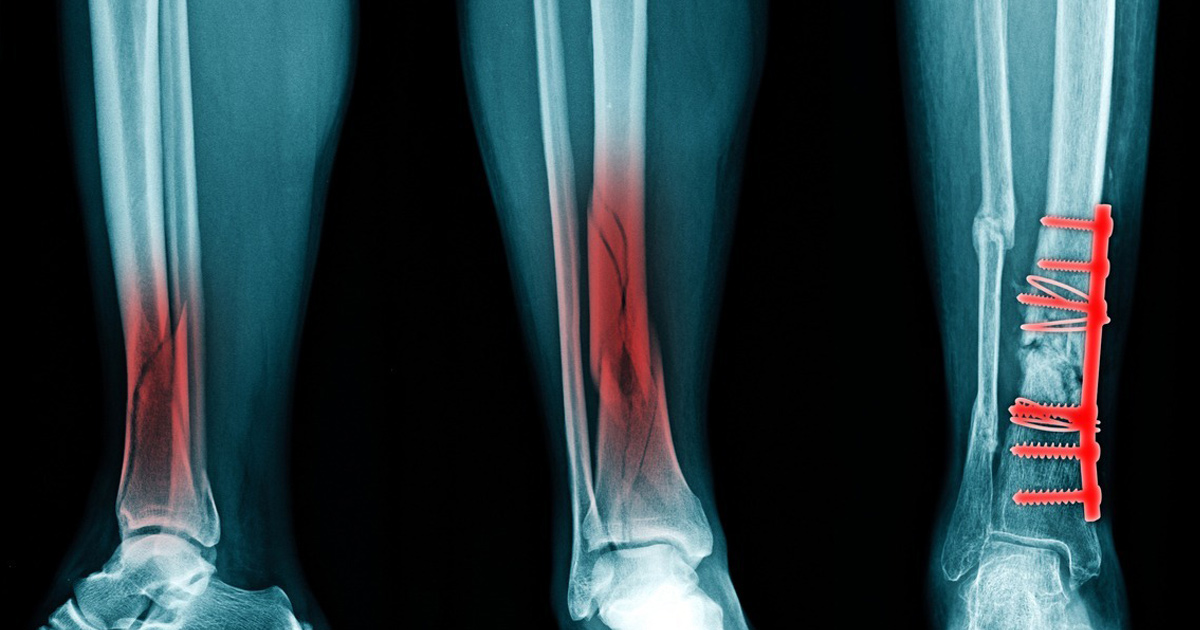
You missed the last step on the stairs, or your foot planted wrong on the soccer field, and now your ankle is swollen, bruised and painful to stand on. Your imaging confirms a break, so will you need surgery right away, or can this heal in a cast or boot? This post explains how we decide when an ankle fracture needs surgery at our Austin and Leander offices.
What Happens When You Break Your Ankle
Your ankle joint is formed by the ends of the two lower leg bones, the tibia and fibula, sitting over the talus bone of the foot. Strong ligaments hold these bones together so the joint can move smoothly while carrying your full body weight. An ankle fracture can involve one bone or several, and it can range from a small crack that barely slows you down to a complex break that makes walking impossible.1
Ankle fractures are among the most common fractures in adults.1
Stable Versus Unstable Fractures
The single most important question is whether your ankle is stable. A stable fracture keeps the bones of the joint lined up correctly, even when you put some load on them. An unstable fracture allows the talus to shift inside the joint, which can change how force travels across the cartilage.
Stable fractures, such as an isolated break of one bone with no shift of the joint, are often treated without surgery using a cast or walking boot.2 Unstable fractures are generally treated surgically, because the goal is to restore the normal alignment of the ankle joint and hold it there while the bone heals.2
Signs Your Fracture May Need Surgery
Several findings on your exam and imaging can point toward an operation. Your fracture may need surgical repair if:
- The bones have shifted out of position and cannot be held in good alignment with a cast alone
- More than one bone is broken, as in bimalleolar or trimalleolar fractures2
- The talus has shifted within the joint on weight bearing imaging2
- The break extends into the joint surface, as seen with pilon fractures
- The ligaments that bind the tibia and fibula together, called the syndesmosis, are also torn
- The skin is broken over the fracture, or the joint is dislocated
These injuries overlap with what many people call a high ankle sprain, and when they accompany a fracture, they may need their own stabilization.
What Ankle Fracture Surgery Involves
The most common procedure is open reduction and internal fixation of the ankle. The bones are realigned, which is the reduction, and then held in place with plates, screws or other fixation, which is the internal fixation. When swelling is significant, surgery may be delayed for several days so the soft tissues can settle and lower the risk of wound problems.2
When you see us, your care is guided by a board certified, fellowship trained orthopedic foot and ankle surgeon who is frequently sought for second opinions on complex foot and ankle trauma and revision care. Every plan for ankle fracture surgery is shaped around your fracture pattern, your bone quality and your activity goals.
When Surgery May Not Be the Best Choice
Surgery is not always the right answer, even for some displaced fractures. Poor soft tissue condition, significant medical problems or limited activity demands can make careful nonoperative treatment a reasonable path.2 We will walk you through the tradeoffs so the decision fits your health and your life.
What Recovery Typically Looks Like
Most ankle fractures take at least six weeks for early bone healing and about 10 to 12 weeks for more complete healing, while ligaments and tendons can take longer.1 After surgery, you can usually expect a period of limited weight bearing in a splint or boot, followed by gradual return to walking and a course of rehabilitation. Following your postoperative instructions closely helps protect the repair. Many people return to normal daily activities within a few months, though returning to running or sports can take longer, and results vary from person to person.1
Frequently Asked Questions About Ankle Fracture Surgery
Can a broken ankle heal without surgery?
Yes, many stable ankle fractures heal well without surgery. A cast or walking boot is often enough when the bones stay aligned and the joint remains stable.
How soon should you see a specialist for an ankle fracture in Austin?
You should see a foot and ankle specialist in Austin as soon as possible after the injury. Early evaluation helps confirm stability and allows surgery, if needed, to be planned before healing begins in a poor position.
How long after ankle fracture surgery can you walk?
Many patients begin protected walking in a boot several weeks after surgery. Your exact timing depends on the fracture, the repair and how healing looks on follow up imaging.
Will the plates and screws need to be removed?
Most patients keep their hardware permanently without problems. Removal may be discussed if the hardware causes irritation or pain after the bone has healed.
Can you walk on a broken ankle and make it worse?
Yes, walking on an unstable fracture can shift the bones further out of place. If you suspect a break, keep weight off the ankle until it has been evaluated.
Get Clear Answers About Your Broken Ankle in Austin and Leander
A broken ankle can feel overwhelming, but knowing whether your fracture is stable gives you a clear starting point. Whether your path is a boot or a surgical repair, a careful evaluation helps you move forward with confidence. When you are ready, you can schedule a visit at our Austin or Leander office to review your imaging and options.
References
- AAOS OrthoInfo. Ankle Fractures (Broken Ankle). American Academy of Orthopaedic Surgeons. https://orthoinfo.aaos.org/en/diseases--conditions/ankle-fractures-broken-ankle/
- StatPearls. Ankle Fracture. StatPearls Publishing, NCBI Bookshelf. https://www.ncbi.nlm.nih.gov/books/NBK542324/
Dr. Andrew Ebert, MD is a board-certified, fellowship-trained orthopaedic foot and ankle surgeon serving patients in Austin and Leander, Texas. He earned his medical degree from the University of Texas Medical Branch, completed his orthopaedic residency at Baylor College of Medicine, and trained in foot and ankle surgery at OrthoCarolina's O.L. Miller Foot and Ankle Institute. A partner at Orthopaedic Specialists of Austin since 2007, he cares for athletes at UT Austin and Austin FC.